


What Is Data in View? Understanding the Next Layer of Data Security
Data at Rest, Data in Transit, and Data in Use, these categories provide the foundation for protecting information as it is stored, transmitted, and processed across enterprise environments.
However, the way people interact with information has changed significantly. Cloud applications, remote work, virtual desktops, AI-powered tools, and collaborative platforms have made screens the primary interface for accessing business data. Every day, employees, contractors, partners, and third parties rely on visual access to sensitive information to perform their work.
This shift has introduced another perspective in the data lifecycle: Data in View.
Data in View describes the moment sensitive information becomes visually accessible to a person. While it is not traditionally recognized as one of the core data states, it represents an increasingly important concept for understanding how information is consumed in modern digital environments.
What Is Data in View?
Data in View refers to sensitive information that is visually displayed for human interaction, whether on a computer monitor, laptop, mobile device, virtual desktop, digital dashboard, or printed document.
Unlike data that is stored, transmitted, or processed behind the scenes, Data in View represents information at the point where it becomes visible to an authorized user for legitimate business purposes, enabling them to read, analyze, and act upon it.
Data in View complements the broader discipline of Visual Data Security, which focuses on protecting sensitive information once it becomes visually accessible.
How Data in View Fits Within the Data Lifecycle
Information continuously moves through different stages during its lifecycle. Traditionally, cybersecurity has focused on protecting data in three primary states.
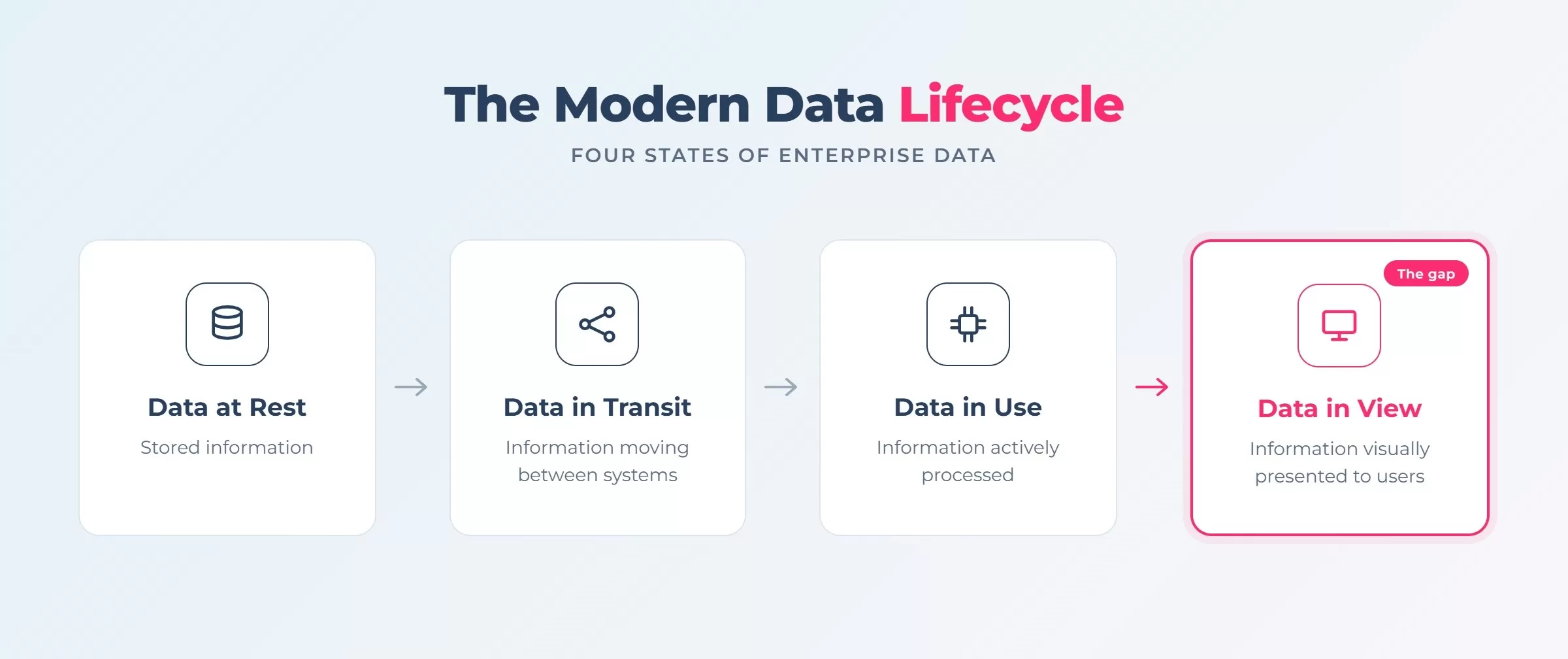
Data at Rest | Information stored in databases, file systems, or cloud storage. |
Data in Transit | Information moving between users, applications, devices, or networks. |
Data in Use | Information actively processed by applications, operating systems, or memory. |
Görüntülenen Veriler | Information visually presented to users through screens or printed materials. |
Each state describes a different way information exists and interacts with systems or users.
While Data in View is not a replacement for these established classifications, it offers an additional perspective that focuses on how information is consumed rather than where it is stored or processed.
As organizations increasingly rely on digital interfaces, understanding this visual stage helps create a more complete view of the information lifecycle.
Why Data in View Matters
The modern workplace is increasingly visual.
Employees rarely interact directly with databases or backend systems. Instead, they access information through applications, dashboards, collaboration platforms, virtual desktops, AI assistants, and cloud services that present data in an easily consumable format.
At the same time, organizations are embracing:
- Hybrid and remote work
- Cloud-native applications
- Software-as-a-Service (SaaS) platforms
- AI-powered productivity tools
- Digital collaboration environments
- Real-time business dashboards
These technologies have transformed how information is delivered and consumed, making visual access an integral part of everyday business operations.
As a result, understanding Data in View helps organizations recognize an increasingly important aspect of how sensitive information is accessed across modern enterprise environments.
Characteristics of Data in View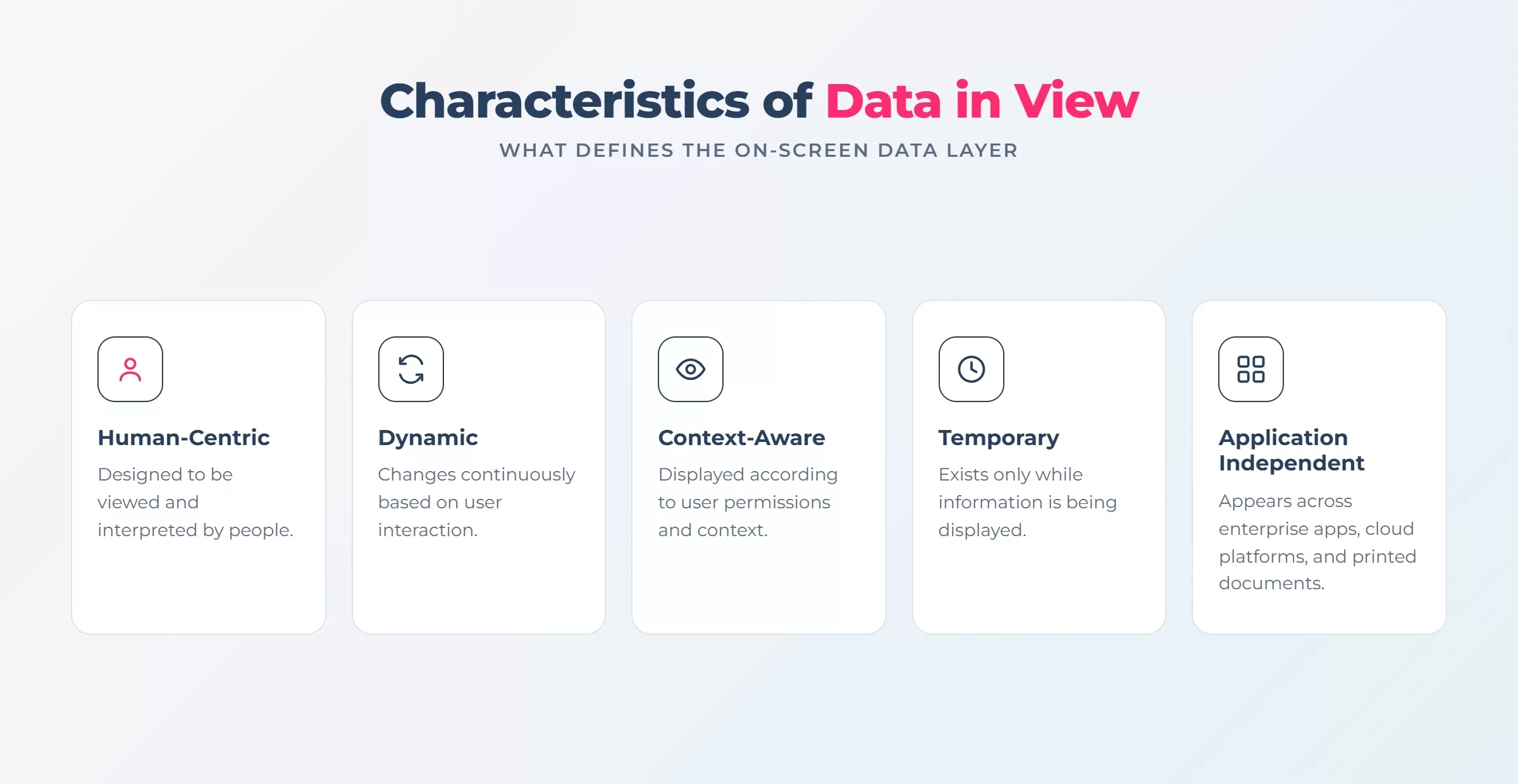
Unlike traditional data states, Data in View has several unique characteristics.
Human-Centric
Data in View exists primarily to communicate information to people. Its purpose is to support decision-making, collaboration, analysis, and daily business operations.
Dynamic
The information displayed on screen changes continuously based on user actions, application logic, permissions, and business context.
Context-Aware
Different users may view different information within the same application depending on their role, location, or level of authorization.
Temporary
Unlike stored records, visual information often exists only while it is displayed. Once a screen changes, the visible content may no longer be available in that form.
Application Independent
Data in View is not limited to a specific platform or system. It can appear across enterprise applications, cloud services, virtual desktops, mobile devices, business intelligence platforms, and printed materials.
Examples of Data in View
Almost every organization works with Data in View throughout the day.
Common examples include:
- Customer profiles displayed in CRM systems
- Financial performance dashboards
- Patient records viewed during medical consultations
- Security operation center (SOC) monitoring dashboards
- Manufacturing production interfaces
- Legal case files
- Human resources records
- Source code displayed in development environments
- AI chatbot responses containing proprietary information
- Printed contracts awaiting approval
Although these examples span different industries, they all share one characteristic: information is presented visually to enable human interaction.
Organizations looking to protect Data in View often implement specialized Visual Data Security technologies designed to address visual exposure risks.
The Growing Recognition of Data in View
Enterprise data security has traditionally focused on protecting information as it moves through technical systems.
Today, however, organizations are recognizing that digital transformation has fundamentally changed how people interact with data.
Business users spend most of their day working through graphical interfaces, cloud applications, collaboration platforms, AI assistants, and virtual workspaces, not directly with databases or network infrastructure.
As these environments become more central to daily operations, security discussions are naturally expanding beyond traditional data states to include how information is visually presented and consumed.
This evolving perspective has contributed to growing interest in the concept of Data in View as organizations seek a more complete understanding of the modern information lifecycle.







Comments (4)
Middle East Cost of Data Breach Reaches $8M, IBM Finds
27 August, 2026[…] that point, the data can potentially be copied, photographed, captured, recorded or printed. These actions may fall outside controls designed primarily to protect stored files, network […]
6 Roles Exposed to Visual Data Risk | DataPatrol
31 August, 2026[…] information is visible, it may be photographed, recorded, copied, or shared outside authorized channels. The following six […]
Insider Threat Awareness Month: Protecting Data in View
22 September, 2026[…] organizations strengthening their insider-risk programs, protecting data in view is an important part of addressing the human element of […]
Centralized Screen Watermarking for Remote Teams
30 September, 2026[…] sensitive information appears on a screen, it enters a new state: Data in View. A person can now read it, and that visible content can be photographed, captured, or seen by an […]