
What Is Visual Data Security? Definition & Best Practices
Understanding the growing risks of data in view, visual exposure, and insider-driven screen data leaks.
As organizations become increasingly digital, sensitive information is constantly exposed across screens, remote sessions, mobile devices, shared workstations, and printed documents. While cybersecurity strategies continue to evolve, many traditional controls still struggle to address what happens once data becomes visually accessible.
Screenshots, smartphone photos, screen sharing, copy-paste actions, and visual observation create a growing layer of exposure that is difficult to monitor, control, or investigate through conventional security tools alone.
This growing visibility gap is driving organizations to strengthen their Visual Data Security strategies.
The Evolution of Data Protection
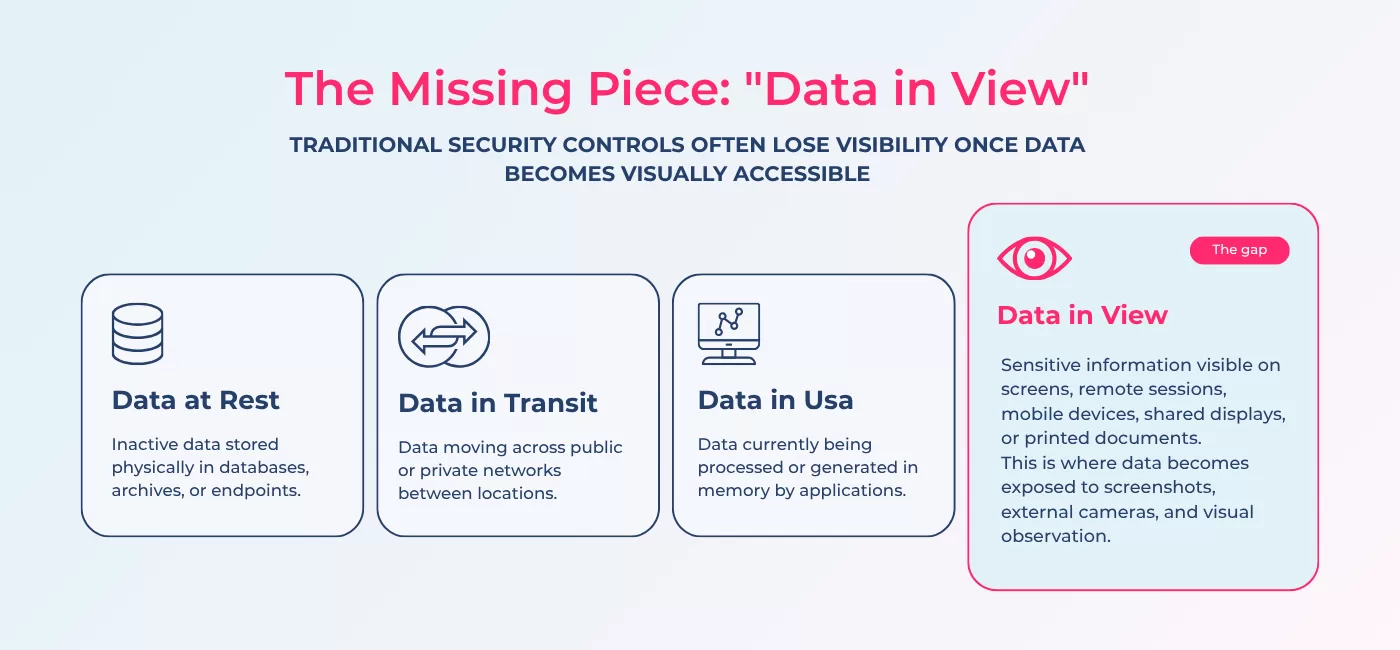
Traditional security frameworks classify data into three core states:
Data at Rest: Inactive data stored in databases, cloud environments, archives, or endpoints.
Data in Transit: Data moving across networks, applications, and communication channels.
Data in Use: Data actively processed by applications or systems in memory.
These layers remain essential. However, modern work environments have introduced a fourth state that is increasingly exposed and difficult to control: “Data in View.”
Understanding Data in View
Data in View refers to sensitive information currently visible to human eyes on screens, in remote sessions, on shared displays, on mobile devices, or in printed documents. This is the point at which information becomes visually accessible.
Once data appears on a screen, organizations face a different type of security challenge:
- A user can photograph the screen with a personal phone
- Sensitive information can be exposed during screen-sharing sessions
- Employees can capture screenshots without triggering traditional DLP alerts
- Data can be copied into unsanctioned AI tools
- Printed documents can be leaked without attribution
- Sensitive content can be viewed by unauthorized individuals nearby
Traditional security solutions were not originally designed to address these forms of visual data exposure.
What Is Visual Data Security?
Visual Data Security is the practice of protecting sensitive information once it becomes visually accessible.
It focuses on securing data displayed on screens, printed documents, web applications, virtual desktop environments, and mobile devices through technologies that provide deterrence, traceability, attribution, and visual control.
Unlike traditional security layers that focus primarily on controlling access or file movement, Visual Data Security protects information after access has already been granted.
The goal is not only to prevent unauthorized exposure but also to transform previously invisible insider risk activities into attributable, investigable events.
Why Traditional Security Tools Leave a Visual Gap
Many organizations already operate mature security stacks, including DLP, DRM/IRM, EDR, SIEM, and Zero Trust architectures. While highly effective in many areas, these technologies often struggle once information becomes visible on screen.
DLP Limitations
DLP solutions are designed to monitor file transfers, emails, uploads, and data movement across networks. However, they cannot stop someone from taking a photo of a screen using a personal device.
DRM and IRM Limitations
Digital Rights Management tools focus on file-level controls and encryption. Once data is displayed to an authorized user, the visual layer remains exposed.
Zero Trust Limitations
Zero Trust reduces unauthorized access and lateral movement, but does not monitor how visible data is consumed after legitimate access is granted.
The “Analog Hole”
One of the biggest challenges in modern cybersecurity is the analog hole: the ability to capture digital information through non-digital means such as smartphone photography, visual observation, or external recording devices.
This creates a major blind spot in enterprise security programs.
Why Visual Data Exposure Is Increasing
Several converging trends are accelerating visual risk across organizations.
Hybrid and Remote Work
Distributed work environments have expanded the number of locations where sensitive data becomes visible outside controlled office environments.
AI and Shadow AI Usage
Employees increasingly paste sensitive information into AI tools for summarization, analysis, or productivity, creating new forms of insider risk and visual exposure.
Increased Insider Risk
Insider threats continue to rise across industries, particularly involving intellectual property theft, financial data exposure, and unauthorized information sharing.
Screen-Centric Workflows
Modern enterprises operate through dashboards, SaaS applications, trading systems, EHR platforms, remote sessions, and collaborative workspaces where critical data is continuously displayed on screen.
As organizations become more digital, visual exposure becomes more frequent.
Common Visual Data Exposure Risks
Visual data exposure can occur across nearly every industry.
Financial Services
Relationship managers or traders may photograph sensitive client information, transaction systems, or proprietary financial data directly from screens.
Healthcare
Patient records displayed on EHR systems may be captured through screenshots or personal mobile devices, exposing protected health information.
Government and Defense
Classified or regulated information displayed during remote sessions or operational workflows may be leaked through visual capture methods.
Manufacturing and Engineering
CAD designs, product prototypes, and intellectual property displayed on engineering workstations can be visually exfiltrated without triggering conventional security alerts.
Corporate Environments
Employees may copy confidential information into unauthorized AI platforms or capture screenshots from internal applications.
In many of these cases, traditional logging systems provide little or no forensic visibility into what actually occurred visually.
Visual Data Security & Compliance
As regulatory expectations around data protection continue to evolve, organizations are under increasing pressure to improve visibility, accountability, and control over sensitive data exposure. While frameworks such as GDPR, HIPAA, PCI DSS, NCA ECC, and SAMA CSF require organizations to protect sensitive data and strengthen insider risk controls, many traditional security approaches still provide limited visibility once information becomes visually accessible.
Visual Data Security helps organizations strengthen auditability, traceability, and accountability around visible data interactions across screens, remote sessions, printed documents, and digital workflows.
By reducing exposure of anonymous data and improving forensic visibility, Visual Data Security can support broader compliance, investigation, and insider risk management strategies across regulated industries.
Visual Data Security Best Practices
As visual data exposure continues to grow in hybrid work environments, organizations should adopt a structured approach to protecting it.
Identify High-Risk Visual Workflows
Start by identifying where sensitive information is most frequently displayed, shared, or exposed. This may include financial dashboards, EHR systems, remote support sessions, trading platforms, internal web applications, and collaborative workspaces.
Apply Persistent Visual Deterrence
Visible deterrence mechanisms, such as dynamic screen watermarking, help discourage unauthorized photography, screenshots, and visual sharing by increasing accountability for visible data interactions.
Restrict Unauthorized Capture Methods
Organizations should implement controls that limit screenshots, screen recording, copy-paste actions, and unauthorized screen-sharing applications within sensitive environments.
Extend Protection Across Remote and Mobile Work
Visual Data Security policies should cover remote sessions, BYOD environments, mobile devices, VDI infrastructures, and browser-based applications to ensure consistent protection across all access points.
Strengthen Insider Risk Monitoring
Security teams should integrate visual exposure controls into insider risk management programs to improve traceability, investigations, and forensic visibility.
Align Policies With Modern Workflows
Security controls should balance protection with usability. Lightweight, low-friction controls are often more effective than restrictive workflows that negatively impact productivity.
Include Visual Exposure in Security Awareness Programs
Employees should be trained on the risks of visual data exposure, including smartphone photography, unauthorized AI use, screen-sharing practices, and handling sensitive visible information in public or remote environments.
Build Visual Audit Trails
Organizations should implement technologies and processes that establish attribution and accountability for visible data interactions, enabling investigators to trace leaks back to specific users, sessions, or devices.
From Prevention to Attribution
One of the most important shifts introduced by Visual Data Security is moving from prevention alone to deterrence and attribution.
Traditional controls often focus on blocking unauthorized access. However, many modern insider incidents occur after legitimate access has already been granted.
In these scenarios, organizations need:
- forensic visibility,
- traceability,
- visual audit trails,
- and evidence linking exposure to specific users or sessions.
This is particularly important for investigations, compliance reporting, insider risk management, and regulated industries.
Visual Data Security helps transform previously untraceable incidents into attributable events.
Why Visual Data Security Matters Now
As organizations continue investing in AI, cloud platforms, hybrid work, and digital collaboration, the amount of sensitive information visible on screens will continue to grow.
At the same time, regulatory expectations around data protection, accountability, and insider risk management are becoming stricter across industries.
Protecting visible data is no longer a niche requirement. It is becoming an essential extension of modern enterprise security strategies.
The future of data protection will not only depend on securing where data is stored or transmitted, but also on securing how it is visually consumed.
Visual Data Security addresses that missing layer.